Words Merge: Search Puzzle
- 4.4
- Rating
- 10.00K
- Installs
- Free
- Price
 Analysis by App-foxy
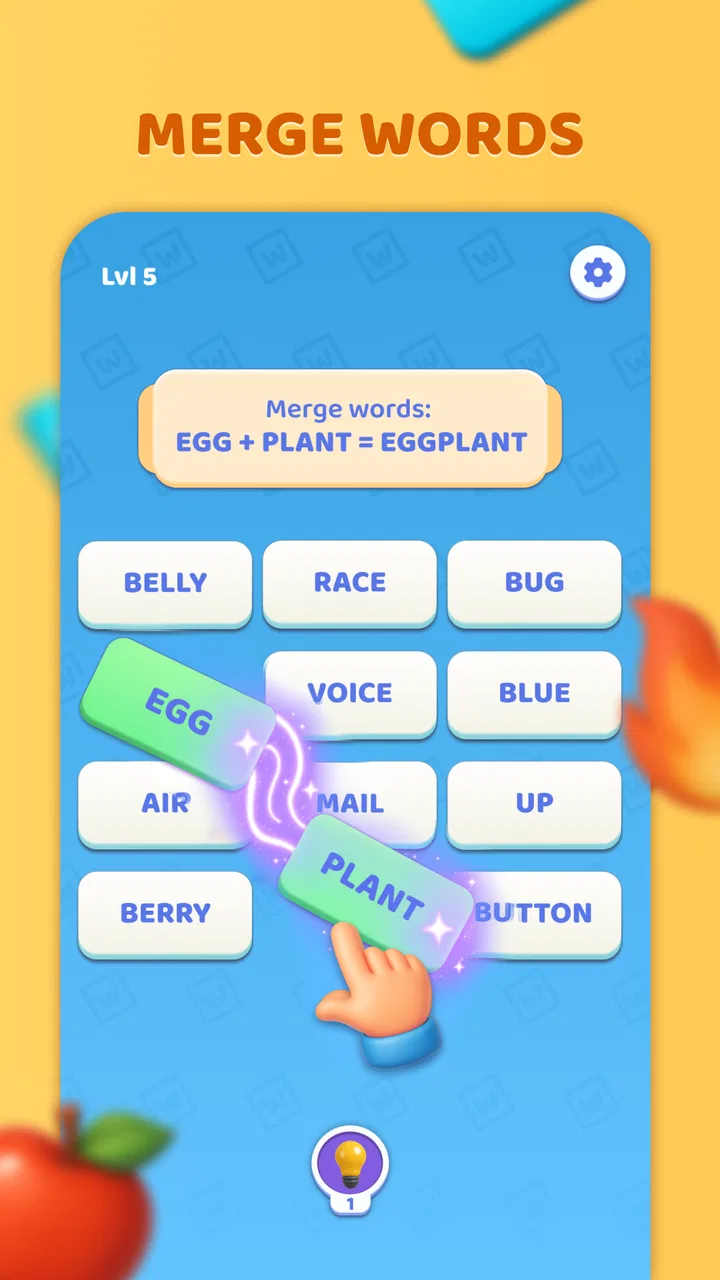
I spent time with Words Merge: Search Puzzle as a compact word game built around finding connections rather than simply spotting isolated answers. Its appeal is easy to understand: you look at the available letters or clues, search for relationships, and try to turn a small puzzle into a satisfying chain of discoveries. The presentation is straightforward, which makes it suitable for a quick break, but the combination of word searching, logic, crossword-style thinking, and associations gives each round a little more variety than a basic word hunt.
What I like most is that it asks me to change the way I think from one moment to the next. Sometimes I am scanning for a familiar word; at other times I am testing whether several answers belong together. That shift keeps the game from feeling like a pure vocabulary test. It is free, rated for Everyone, and developed by MCZ Apps developer, so it is easy to approach as a casual game for a broad audience. The current version is 1.4.0, and the game is available for devices running Android 10 or later.
How the early goals shape the first sessions
The first useful goal in a game like this is not a distant reward or a complicated achievement system. It is learning how the puzzle wants me to read information. Words Merge: Search Puzzle encourages me to stop treating every letter or clue as an isolated object. I have to look for links, possible groupings, and the answer that makes the surrounding pieces make sense. That learning process is the real opening tutorial, even when the individual puzzles feel simple.
You May Also Like

 AccuWeather: Weather Radar
AccuWeather Review: A Quick, Clear Forecast for Everyday Decisions
For everyday plans, the best forecast is the one you can understand quickly. AccuWeather makes rain timing, radar, and local conditions easy to act on, with a few trade-offs.

 Hill Climb Racing
Why Hill Climb Racing Still Turns Crashes Into One More Run
A tiny car, a bumpy hill and one more upgrade: Hill Climb Racing keeps resurfacing because its simple chaos makes every near-miss feel personal.

 AliExpress - Shopping App
AliExpress Makes Global Shopping Feel Personal, but Shoppers Bear the Risk
AliExpress turns a global marketplace into a pocket-sized discovery engine. Its reach is useful, its shopping loop compelling, and its trade-offs easy to miss.

 Lords Mobile: Kingdom Wars
Lords Mobile Is a Kingdom-Building Routine, Not a Quick Match
A case-by-case verdict on the building, battles, device demands, and social commitments that make Lords Mobile rewarding for some players and exhausting for others.

 PDF Scanner app - TapScanner
TapScanner Makes Paperwork Easier to Capture, Check, and Share
TapScanner makes scanning with a phone feel less like a rescue operation and more like a dependable step in getting work done. Its capture tools are useful, though not flawless.

 Block Blast!
 Shows How Much a Puzzle Game Can Leave Out
A quiet grid game shows why puzzle players increasingly value instant clarity, repeatable skill and low-pressure play—and where the genre still needs to catch up.
More From Our News Desk
View All News


I found the early puzzles most enjoyable when I approached them with a deliberate routine. I first scan for obvious words, then check whether those words suggest a theme or association, and only after that do I spend time on the less certain possibilities. This is more effective than tapping randomly because a correct answer often changes how the remaining puzzle should be viewed. The game rewards observation and flexible thinking more than speed, which makes it comfortable for players who prefer a calm challenge.
That early structure also makes the game accessible to different ages. A younger player can focus on familiar vocabulary and visible patterns, while an adult can treat the same board as a short logic exercise. The Everyone rating fits that broad design. I would still play alongside a child who is developing vocabulary, not because the game is intimidating, but because word associations can depend on language experience and personal familiarity.
One practical use case is a short waiting period when I want something more mentally active than scrolling. A few puzzles can fill a bus ride, a coffee break, or the gap before an appointment without demanding a long uninterrupted session. The important distinction is that the game gives me a small objective immediately. I do not need to remember a complex story or reconstruct a large map before I can enjoy the next few minutes.
Why the opening feels approachable
The blend of word search and association play gives new players several ways into the game. If I am good at visual scanning, I can begin by identifying direct word possibilities. If I am stronger at language connections, I can use the relationship between answers to guide the next move. If I prefer logic, I can eliminate options that do not fit the emerging pattern. That flexibility is a genuine strength because it prevents the opening from becoming a narrow spelling exam.
There is also a useful mental habit hidden in the format: I learn to hold a tentative answer without becoming attached to it. A word may look convincing but fail to connect with the rest of the puzzle. When that happens, the best move is not to force it; I step back, inspect the unused possibilities, and search for a broader relationship. That makes the game a gentle exercise in revising assumptions, something I rarely get from a standard crossword app focused only on clue-by-clue completion.
Progress signals without turning the game into a checklist
In my experience, the clearest sign of progress is the way I begin to recognize the puzzle’s logic. At first, I look for answers one at a time. After playing for a while, I start predicting what kind of connection might be useful before committing to a word. That change matters because it makes later boards feel less like guessing and more like controlled deduction.
The game’s satisfaction comes from completing a relationship between answers, not merely from filling space. A successful move can confirm that several apparently unrelated pieces belong together. That creates a small but meaningful “click” in the mind. For me, this is stronger than the reward of finding an ordinary hidden word because the solution explains more of the puzzle at once.
I also appreciate that the format naturally creates short-term milestones. One solved group gives me a reason to inspect the next one, and a nearly completed board encourages me to reconsider the remaining possibilities instead of abandoning the session. These are modest progress signals, but they are well suited to a casual word title. The game does not need an elaborate narrative to make a completed puzzle feel worthwhile.
There is a trade-off here. Players who need visible long-term progression, collectible items, character upgrades, or a detailed achievement path may find the experience too focused on the puzzles themselves. Words Merge: Search Puzzle works best when solving is the reward. If I want a word game with a strong meta-layer, social competition, or a story that changes as I play, I would look elsewhere.
A better way to read a stubborn puzzle
When I get stuck, I avoid staring at the same promising word for too long. Instead, I sort the remaining possibilities mentally into three groups: words that are almost certainly useful, words that might fit a theme, and words that only look attractive because they are familiar. This simple separation prevents one appealing answer from dominating the whole board.
Another helpful approach is to search for the most restrictive connection first. A broad word can belong to many associations, while an unusual or specific word may point toward the intended group. Once that anchor is identified, the surrounding answers become easier to evaluate. This is a small technique, but it makes the game feel more strategic and reduces the temptation to rely on random tapping.
I also recommend taking a brief pause rather than forcing a solution. Because the game is built around language relationships, a fresh look can be more valuable than repeated attempts with the same assumption. That makes it a good choice for players who enjoy thinking in bursts. It is less suitable for anyone who wants constant action or immediate feedback from every touch.
Difficulty curve and the value of changing perspective
The difficulty in this type of puzzle does not come only from obscure vocabulary. It comes from ambiguity. A familiar word can still be difficult if I cannot see which other answers it belongs with. That is why the challenge feels different from a conventional crossword, where the clue usually defines the direction of the answer. Here, I may know several possible words and still need to determine how they interact.
The most interesting moments occur when the obvious interpretation is not the useful one. I may begin by searching for a direct category, then realize that the connection is based on a shared idea, phrase, or broader association. That shift keeps the difficulty from being purely linear. It tests whether I can move from literal reading to conceptual reading when the first approach stops working.
For casual players, this creates a comfortable challenge as long as expectations are realistic. The game is not simply a relaxing list of easy anagrams. Some puzzles require patience, and progress can slow when several answers appear plausible. I consider that a positive feature in moderation, because a word game without any resistance quickly becomes background tapping. However, players who dislike uncertainty may find the association element less predictable than a standard crossword.
My advice is to treat mistakes as information. If a candidate answer does not help clarify the remaining board, I regard that as evidence that my interpretation is probably too narrow. I then return to the unused words and ask what common idea could connect them. This approach is more productive than trying to memorize a single solving trick, because the game’s challenge comes from relationships that may change from puzzle to puzzle.
Who will enjoy the challenge most
Words Merge: Search Puzzle is a particularly good fit for people who like language games but want more freedom than fixed crossword clues provide. It also suits players who enjoy association exercises, casual brain training, and short sessions that still require concentration. Someone who plays on a phone during a break can make meaningful progress without preparing for a long campaign.
I would be more cautious recommending it to players who need a clearly stated objective beyond solving the current puzzle. The game’s motivation is immediate and local: understand the board, find the connections, and finish the challenge. That is enough for me when I want a quiet mental task, but it may not hold the attention of someone who expects frequent unlocks, dramatic level changes, or a competitive leaderboard.
It is also worth considering language comfort. Word-association games can feel harder when the vocabulary is unfamiliar, when a phrase has multiple meanings, or when the player is working in a second language. That does not make the game unsuitable, but it changes the experience from casual solving to genuine language practice. For a fluent reader, the challenge may feel intuitive; for a learner, it may be rewarding but more demanding.
What keeps the game engaging, and where the pressure stops working
The strongest retention element is the desire to resolve an unfinished idea. When I have identified most of a connection, I naturally want to find the missing piece. That feeling is healthier than a design that depends entirely on constant notifications or artificial urgency. The puzzle itself creates the pull: I want to understand why the remaining words belong together.
Short sessions help as well. I can play for a few minutes and stop without losing the value of the session. If I have more time, I can continue because each completed puzzle resets the mental challenge. This flexible pacing makes the game easy to fit around ordinary routines. It does not demand that I dedicate an entire evening to it, which is one reason I would recommend it as a break-time game.
At the same time, the lack of a stronger external progression layer may limit long-term motivation for some players. Once the novelty of the format settles, continued interest depends heavily on whether the individual puzzles keep offering satisfying discoveries. I do not see that as a flaw in the core concept, but it is an important trade-off. The game is built around solving, not around collecting a growing set of rewards.
For that reason, I would avoid approaching it as a game I must grind every day. It works better as a dependable mental snack. I open it when I want to search, connect, and think for a while, then leave when my attention is spent. That pacing reduces frustration and lets the wordplay remain enjoyable instead of turning every difficult board into a test of endurance.
How it compares with familiar word-game alternatives
Compared with a traditional crossword, this game gives me less support from written clues but more freedom to discover relationships. A crossword is often best when I want a structured grid and precise definitions. Words Merge: Search Puzzle is better when I want to explore how answers fit together conceptually. Neither format replaces the other; they satisfy different kinds of word-game interest.
Compared with a simple word-search game, it asks for more interpretation. A basic word search can be relaxing because the target list is clear and the task is visual. Here, I may need to decide which words matter and how they connect. That adds depth, but it also means the experience is less predictable and occasionally more mentally tiring.
Compared with an anagram game, the focus is not limited to rearranging letters. Anagrams reward quick manipulation of spelling, while this game gives more weight to meaning and association. I would choose an anagram title when I want fast rounds and a clear answer structure. I would choose Words Merge: Search Puzzle when I want to slow down and examine the relationship between possible answers.
That comparison also explains who should skip it. If your ideal word game is a timed competition, a daily score chase, or a highly visual search with no ambiguity, this may feel too thoughtful and unhurried. If you enjoy finding the hidden logic behind a group of words, its slower pace is exactly what makes it worthwhile.
My progression verdict after playing through the format
As a progression-driven word game, Words Merge: Search Puzzle succeeds through gradual mastery rather than spectacle. The early goal is to understand how words can be connected. The progress signal is recognizing those connections faster and with fewer forced guesses. The difficulty comes from changing perspective when a literal answer is not enough. The retention comes from wanting to complete an unfinished pattern.
That is a coherent design, but it is intentionally modest. I would not install it expecting a large adventure, a character journey, or an extensive reward economy. I would install it because I want a free, approachable word puzzle that combines searching with logic and associations. Its audience is someone who values the act of solving more than the decoration around it.
The game has already attracted over ten thousand installs and holds a 4.4 average from around thirty-three ratings, which suggests a positive early reception while still representing a relatively small player sample. Those figures do not replace personal preference, but they fit my impression: this is a focused casual title with a clear idea rather than an enormous platform trying to serve every type of player.
My everyday recommendation is simple: use it when you have a short window and want your attention engaged, especially if you enjoy switching between vocabulary, visual search, and conceptual reasoning. Start with obvious words, look for the most restrictive relationship, and step away briefly when a puzzle becomes circular. That workflow makes the game more satisfying and avoids turning a small challenge into unnecessary frustration.
Overall, I think MCZ Apps developer has made a pleasant choice for players who want word puzzles with a little more interpretation than a standard search grid. The free price and Everyone rating make it easy to try, while the Android 10 minimum keeps the technical requirement clear. The best reason to play is the moment a scattered set of words suddenly becomes one understandable pattern. If that kind of discovery sounds rewarding to you, this is a worthwhile addition to a casual puzzle folder; if you need deep unlocks or competitive pressure, a more feature-heavy alternative will probably keep you engaged longer.
FAQs for Words Merge: Search Puzzle
01What is Words Merge: Search Puzzle?
Words Merge: Search Puzzle is a captivating mobile game that challenges players to find and merge words on a grid. The game combines elements of word search and puzzle-solving, providing an engaging experience for word enthusiasts. It's available for both Android and iOS devices.
02How do you play Words Merge: Search Puzzle?
In Words Merge: Search Puzzle, players are presented with a grid filled with letters. The objective is to find words by connecting adjacent letters without lifting your finger. Once a word is formed, the letters merge, making room for new letters and potential words. The game requires strategic thinking and a keen eye for possible word formations.
03Are there different levels or modes in Words Merge: Search Puzzle?
Yes, Words Merge: Search Puzzle offers multiple levels with increasing difficulty. Each level presents a unique grid and set of challenges, keeping the gameplay fresh and exciting. Additionally, there are various modes, such as timed challenges and special events, to test your skills and keep you engaged.
04Is Words Merge: Search Puzzle free to play?
Words Merge: Search Puzzle is free to download and play. However, like many mobile games, it includes optional in-app purchases for players who wish to enhance their experience. These purchases might include hints, ad removal, or special power-ups to help solve tougher puzzles.
05What are some tips for succeeding in Words Merge: Search Puzzle?
To excel in Words Merge: Search Puzzle, start by scanning the grid for potential words and focus on high-scoring letters. Utilize power-ups wisely and plan your moves to create cascading merges. Regular practice will also improve your ability to spot words quickly, enhancing your overall performance.
Pros
- Engaging gameplay with challenging puzzles.
- Visually appealing and intuitive interface.
- Regular updates with new levels and features.
- Offline mode available for on-the-go play.
- Suitable for all ages
- promoting brain activity.
Cons
- Contains ads that can disrupt gameplay.
- In-app purchases may be necessary for progress.
- Limited hints can be frustrating for beginners.
- Requires significant storage space on device.
- No multiplayer mode to compete with friends.

Words Merge: Search Puzzle
Gallery